London’s XRlabs raises $8.4m for surgical AI and US regulatory push
The London surgical software company, which already has a Palo Alto office, has secured US-led seed funding to expand its teams, build clinical evidence and pursue regulatory pathways.
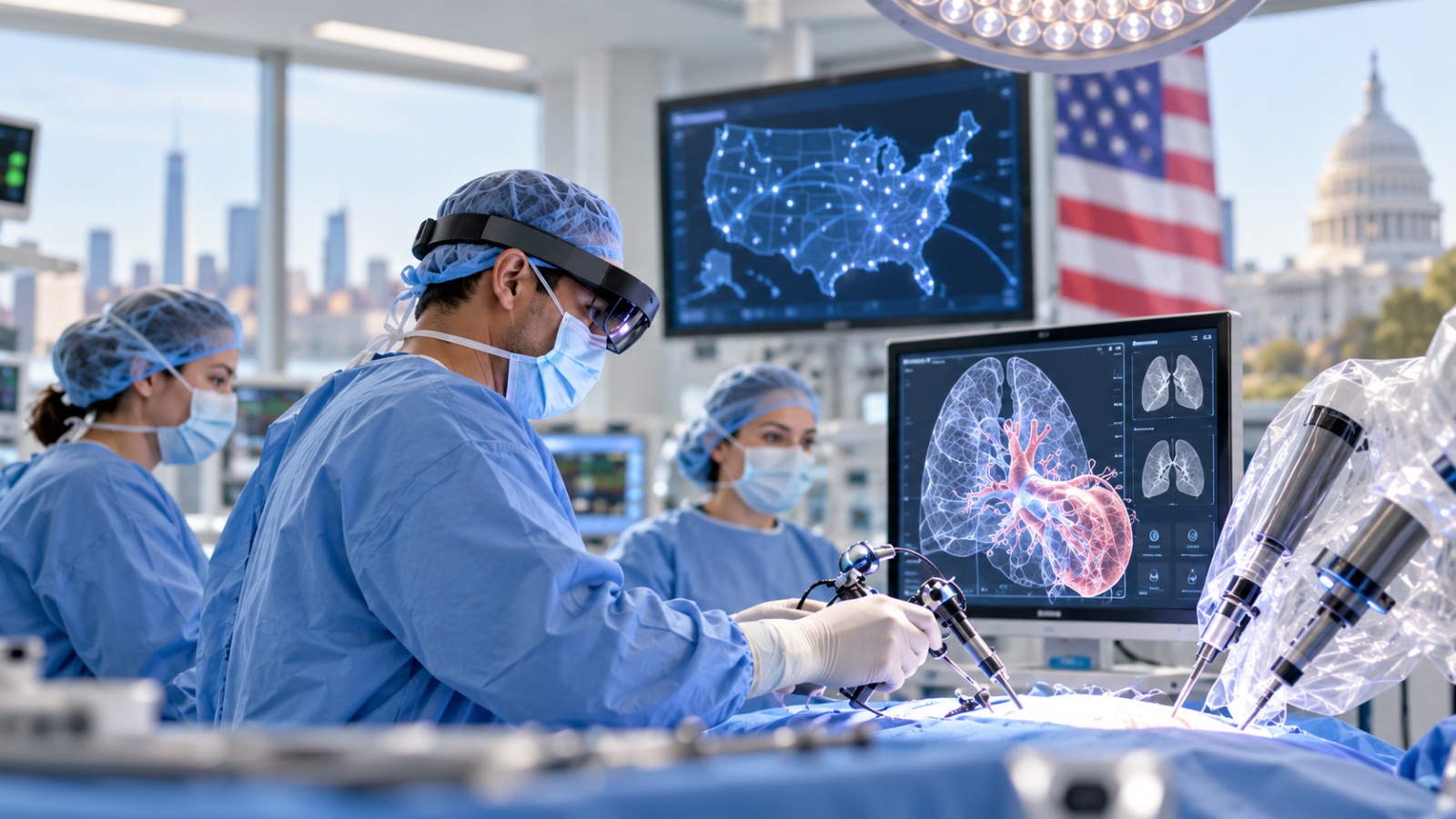
London-based XRlabs has raised $8.4 million (€7.48 million) in seed funding to develop its AI-powered surgical software and advance regulatory work in the United States, the UK and Europe. Palo Alto-based deeptech investor Playground Global led the round, with participation from London healthtech investor Eka Ventures.
Announced on October 19, the financing builds on an existing American foothold rather than marking a first US office opening. XRlabs already has offices in Palo Alto alongside its London headquarters. It plans to grow its engineering and clinical teams and expand the evidence base for its technology at partner institutions across three continents.
The company also appointed Omar Ishrak as chair of its board. Ishrak led Medtronic as chairman and chief executive from 2011 to 2020 and previously chaired Intel’s board. He currently serves on the boards of Amgen and Cleveland Clinic, adding medical-device and hospital governance experience as XRlabs works towards broader adoption.
An AI layer, not a hardware replacement
Founded in 2024 by practising neurosurgeon Dr. Ali Haddad, XRlabs is headquartered at the London Institute for Healthcare Engineering. Its approach is to place modular, device-agnostic software over the surgical equipment hospitals already own, rather than require them to replace those systems.
The platform uses computer vision and deep learning to combine live surgical video, navigation telemetry and pre-operative CT and MRI scans into a real-time view of surgical anatomy. XRlabs says it has demonstrated integration with 4K 3D surgical scopes and navigation systems.
Its two core products connect preparation with the operation itself. XRlabs SIM turns standard CT and MRI scans into interactive three-dimensional models, or digital twins, for patient-specific planning and rehearsal. SurgicalOS brings that digital twin into the live operative view as an intraoperative intelligence layer.
That positioning matters to its US strategy: XRlabs is seeking a place within existing operating-room infrastructure, not selling a replacement surgical system. Its proposition rests on making installed equipment work together and providing useful information during procedures. The funding therefore supports both software development and the clinical and regulatory work needed to pursue hospital adoption.
“Our conviction is that the operating room is the next frontier for physical AI,” Haddad said in the funding announcement. “Surgery generates extraordinary data, yet almost none of it becomes intelligence in the moments that matter most.”
Clinical use precedes a broader rollout
XRlabs says its platform has been used in more than 100 surgical cases across three continents. The announcement does not break those cases down by country or identify US deployment sites, so that total should not be read as a measure of American commercial traction.
Among its reported milestones is what the company describes as first-in-human use of physical AI in cranial neurosurgery, integrated with an ORBEYE 4K 3D exoscope under research conditions. It also reports work on AI-designed, patient-specific implants used in the successful separation of craniopagus twins, in partnership with UK charity Gemini Untwined.
The company’s development effort also draws on US technology infrastructure. XRlabs says it has been named a global NVIDIA partner in robotics and is using NVIDIA Jetson Thor and NVIDIA Isaac for Healthcare technologies for surgical perception, tool tracking and automation capabilities.
In the UK, it has received a compute allocation through the government’s AI Research Resource to support development, testing and scaling. That complements the seed financing while keeping a significant part of its research base anchored in Britain.
For its American ambitions, the next steps are regulatory progress and a broader clinical evidence base. The announcement sets out plans to pursue US regulatory pathways but does not announce a US clearance or a commercial launch timetable. The round strengthens XRlabs’ capacity to pursue that work; it is not, by itself, evidence of a nationwide hospital rollout.