Skeleton tops $1bn valuation as Siemens backs US AI power expansion
Estonia’s Skeleton Technologies plans US cell manufacturing and Silicon Valley R&D as Siemens backs its push into AI data-centre power systems.
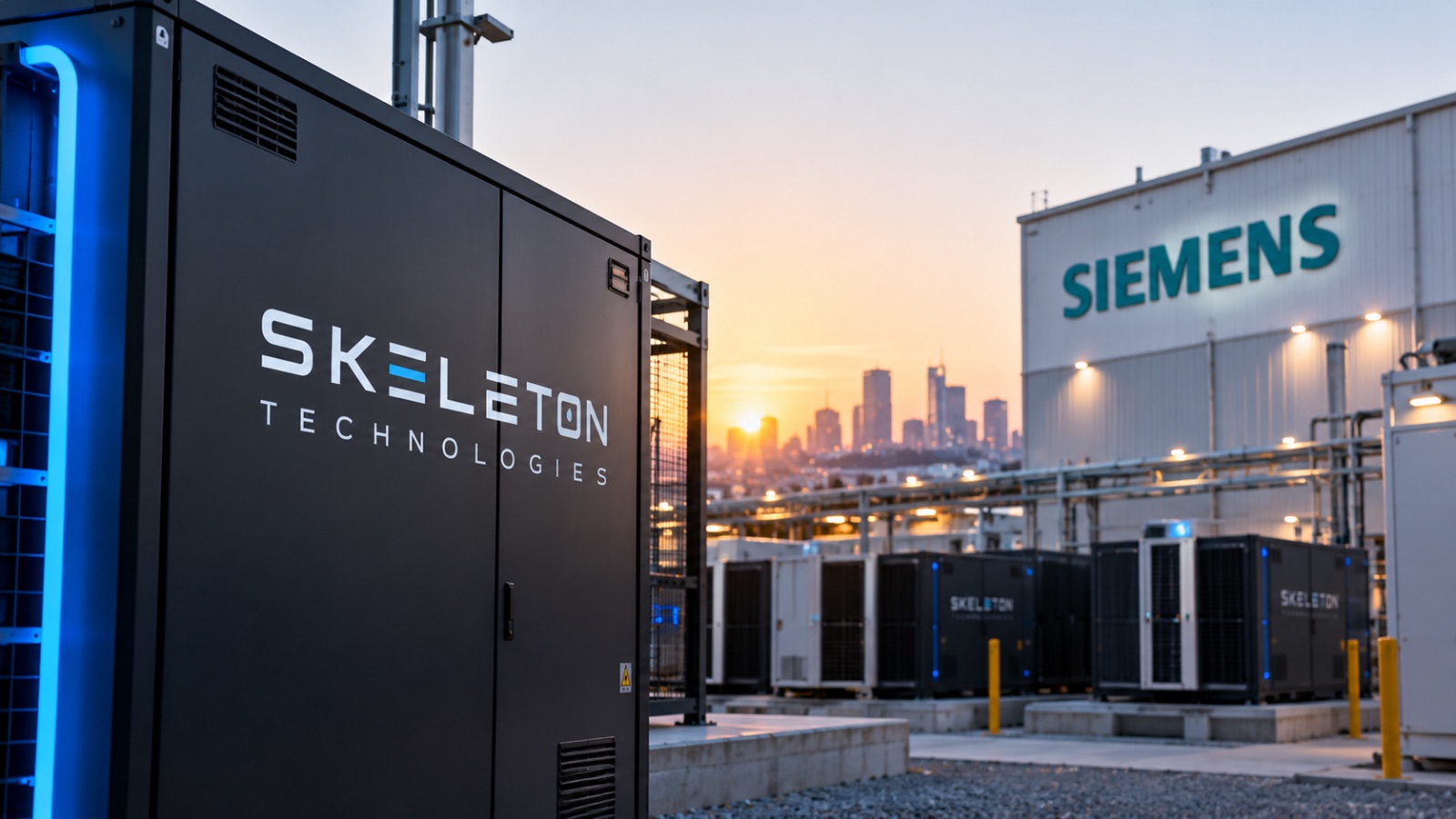
Skeleton Technologies has announced a Siemens investment valuing the Estonian energy-storage company at more than $1 billion, with the funding primarily intended to accelerate US manufacturing and research into power systems for AI data centres.
The Tallinn-based company described the financing announced on October 14 as a “9-digit investment” led by Siemens. The Next Web reported that it exceeded $100 million, citing the company, although the exact amount was not disclosed. Skeleton separately plans to spend more than $200 million on US operational expansion and R&D, including work with hyperscalers in Silicon Valley.
The manufacturing plan includes domestic cell production, with the aim of building an integrated US supply chain from energy-storage cells to complete power systems. The reports do not identify a factory location, construction timetable or production capacity.
A bet on the power behind AI
Skeleton’s US strategy targets a constraint that buying more processors alone cannot solve: delivering stable power to densely packed AI computing equipment. GPU clusters can change their electricity demand within milliseconds, creating rapid load swings that affect equipment and the wider electrical system.
The company’s supercapacitor-based systems absorb those fluctuations close to the computing workload. Its proprietary Curved Graphene material sits at the core of cells designed for rapid power delivery, which Skeleton combines with power electronics and system-level controls.
“AI is scaling faster than the power infrastructure behind it. The constraint is not how many GPUs you can buy, but how much compute you can extract from every GPU and every megawatt available,” chief executive Taavi Madiberk said.
Skeleton claims its systems can deliver up to 40% energy savings and double-digit improvements in GPU performance. Those figures are company claims; the supplied reports do not provide independent testing or specify the operating conditions behind them.
The US market is central to the investment case. EU-Startups reports, citing the International Energy Agency, that data centres are expected to account for around half of US electricity-demand growth through 2030. Manufacturing locally would also bring Skeleton closer to what it describes as its largest AI infrastructure customers.
Siemens brings a route to customers
The agreement goes beyond financing. Data Centre Magazine reports that Siemens has signed an exclusive partnership with Skeleton. The Next Web, citing Siemens technology chief Peter Koerte’s comments to Bloomberg, describes this as an exclusive right for Siemens to sell Skeleton’s high-power storage systems to data centres.
That gives Skeleton a route into a market where Siemens already supplies electrical infrastructure. According to Data Centre Magazine, Siemens supports nine of the ten largest global data-centre providers. The partners intend to combine that infrastructure portfolio with Skeleton’s fast-response systems, addressing power requirements from the grid connection to the computing racks.
The companies say the technology can be deployed in existing alternating-current architectures and retrofit projects, while providing a pathway towards future 800-volt direct-current systems. That positions the offering for upgrades as well as new facilities, with the aim of increasing computing density without a complete redesign.
From German production to a US supply chain
Founded in 2009, Skeleton supplies high-power systems for applications including electrical grids, defence and critical infrastructure, alongside AI data centres. Its relationship with Siemens began as a technology partnership in 2022; Siemens became an investor in 2023.
The European manufacturing relationship provides a foundation for the American push. Siemens Digital Industries designed and automated Skeleton’s Leipzig SuperFactory in Germany. The new investment extends that relationship towards US production and product development with hyperscale customers.
Skeleton had already announced a €33 million first close in May 2026, taking cumulative venture funding at that point to €392 million, according to EU-Startups. It is also preparing for a planned US stock-market listing in 2027.
The strategic shift is therefore broader than a new valuation milestone: Skeleton aims to pair its European manufacturing experience with US production, local engineering and Siemens’ customer reach. The next concrete markers will be factory commitments and deployment details, neither of which was specified in the reports.