Dutch Travel Group Corendon Enters the U.S. With Two Hotels in Miami Beach
Dutch travel group Corendon has entered the American hospitality market with two Miami Beach hotels totaling 192 rooms, connecting its European travel operations with Florida and the Caribbean.
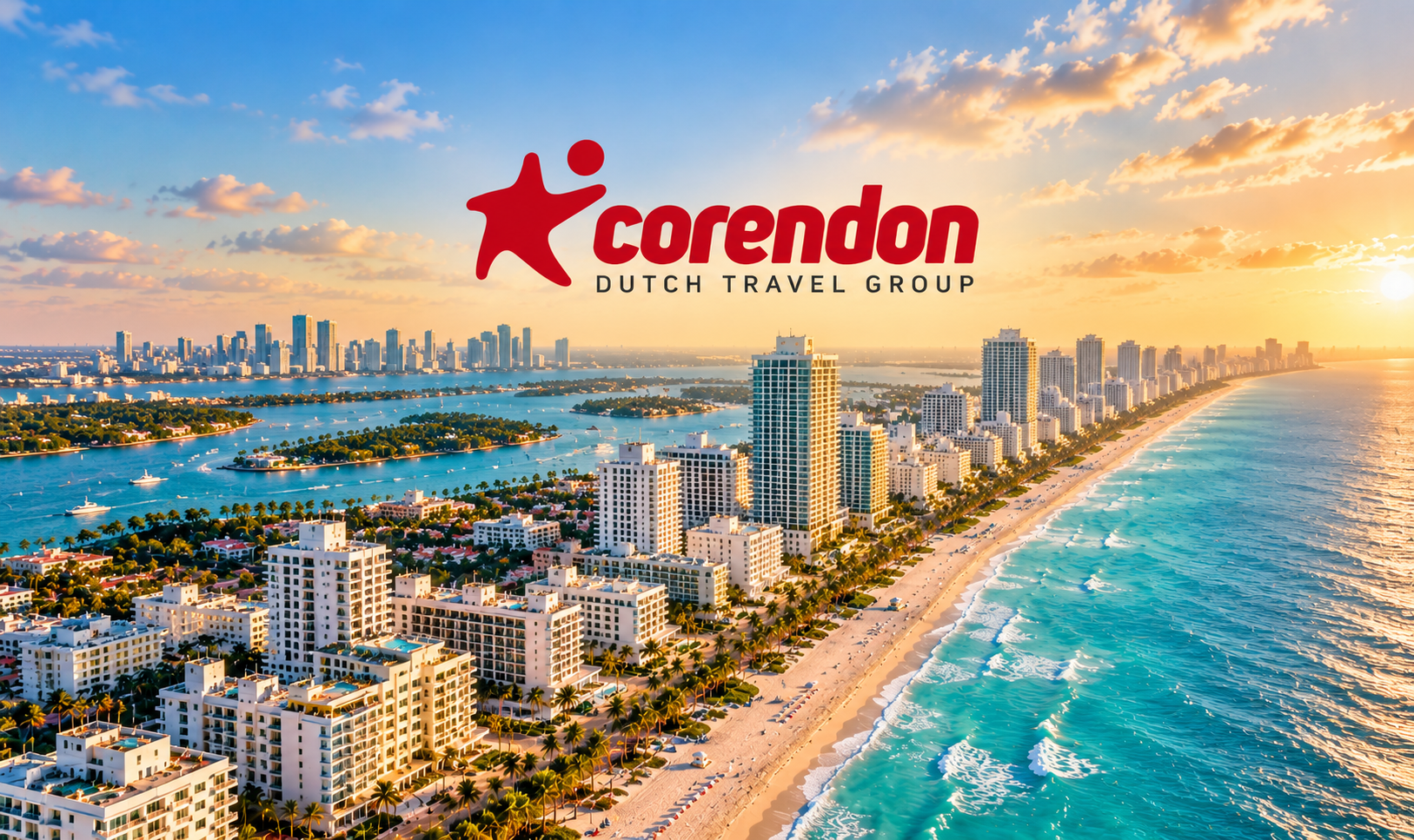
Dutch travel company Corendon has officially entered the U.S. hotel market, opening two properties in Miami Beach as part of its continued international expansion. The Corendon South Beach Miami and Corendon Beach Plaza – South Beach Miami are both located on Collins Avenue in the city's famous Art Deco District. Together, the properties offer 192 rooms and represent Corendon's first hotels in the United States.
For Corendon, however, the Miami launch is about more than adding hotel rooms. The company is combining its new American properties with direct air connections from Europe, vacation packages and car rentals, effectively bringing its vertically integrated European travel model into the U.S. market.
Two Properties in the Heart of South Beach
The larger of the two properties, Corendon South Beach Miami, is located at 944 Collins Avenue. Spread across three buildings, the hotel has 97 rooms, including 25 suites, alongside an outdoor swimming pool, pool deck and fitness facilities. Its location places guests within walking distance of Ocean Drive, South Beach and Miami Beach's restaurants and nightlife.
A few blocks north, at 1401 Collins Avenue, Corendon has opened Corendon Beach Plaza – South Beach Miami. The property contains 95 rooms, including 31 suites, inside an Art Deco building dating back to 1936. According to Corendon, the building was designed by architect L. Murray Dixon, a prominent figure in Miami Beach's historic Art Deco architecture.
Both properties are already available for bookings, giving Corendon an immediate operational presence in one of America's most internationally recognized beach destinations.
Corendon's American Dream
The U.S. expansion has been in development for several months. In June 2026, Dutch travel-industry publication TravMagazine reported that Corendon founder Atilay Uslu was investing in two Miami hotels as the company looked beyond its existing hospitality operations in the Netherlands, Turkey and Curaçao.
The Miami acquisitions were reported as part of a broader investment program of approximately €100 million during 2026. That figure covers wider company investments and should not be interpreted as the purchase price of the Miami properties, which has not been publicly disclosed.
“For me, this is Corendon's American Dream: a Dutch travel company welcoming guests to our very own hotels, right in the heart of Miami.”
The expansion represents another step in Corendon's international hospitality ambitions. The group has established hotel operations in the Netherlands, Turkey and Curaçao, while also pursuing further growth in other markets.
Bringing the European Package Holiday Model to America
What makes Corendon's Miami expansion particularly interesting is how the company intends to attract guests. Rather than operating the hotels purely as independent U.S. properties, Corendon is positioning Miami as a new package-holiday destination for European travelers.
From January 8, 2027, customers will be able to book Miami vacation packages through Corendon using direct KLM flights between Amsterdam and Miami. The arrangement allows Corendon to leverage established airline infrastructure without operating its own transatlantic flights.
One of Corendon's six-day Fly & Go packages has been advertised from €1,299 per person, combining return flights, four hotel nights, airport transfers, parking and a fully insured Ford Mustang Convertible. Beach chair and towel services on South Beach are also included.
This integrated offering reflects Corendon's existing business model: connecting travel distribution, accommodation and additional services into a single vacation product. By bringing that approach to Florida, the company can use its established European customer network to help generate demand for its newly acquired U.S. hotel capacity.
Miami as a Gateway Between Europe and the Caribbean
There is another strategic dimension to the expansion. Corendon's hotel business already has a significant presence in Curaçao, and earlier reporting around the Miami acquisitions suggested that a stronger U.S. presence could help the company attract more American travelers to its Caribbean properties.
Miami provides a logical bridge between these markets. South Florida is a major international tourism destination and an important gateway connecting the United States with Europe, Latin America and the Caribbean.
Corendon can initially leverage its European distribution network to bring travelers into Miami while potentially using its Florida operations to build awareness among American customers. Over time, this could support both inbound European tourism and outbound American travel to other Corendon destinations.
Why It Matters for European Companies Scaling in America
Corendon's expansion illustrates a different approach to entering the United States. Instead of establishing a small representative office and gradually testing demand, the company is entering with physical hospitality assets in one of America's most international tourism markets.
The two Miami Beach properties provide an immediate 192-room operational footprint, while Corendon's existing tour-operator infrastructure offers a way to generate European customer demand from the beginning.
That combination could help reduce one of the biggest challenges of international hospitality expansion: entering a competitive market without an established customer acquisition channel.
Miami may also represent a strategic starting point rather than an isolated investment. Corendon has described the properties as its first steps into the American hotel market, leaving open the possibility of further U.S. expansion.
For European hospitality companies looking across the Atlantic, Corendon's move demonstrates how an established customer base, integrated distribution and carefully selected physical assets can be combined to enter the world's largest economy.