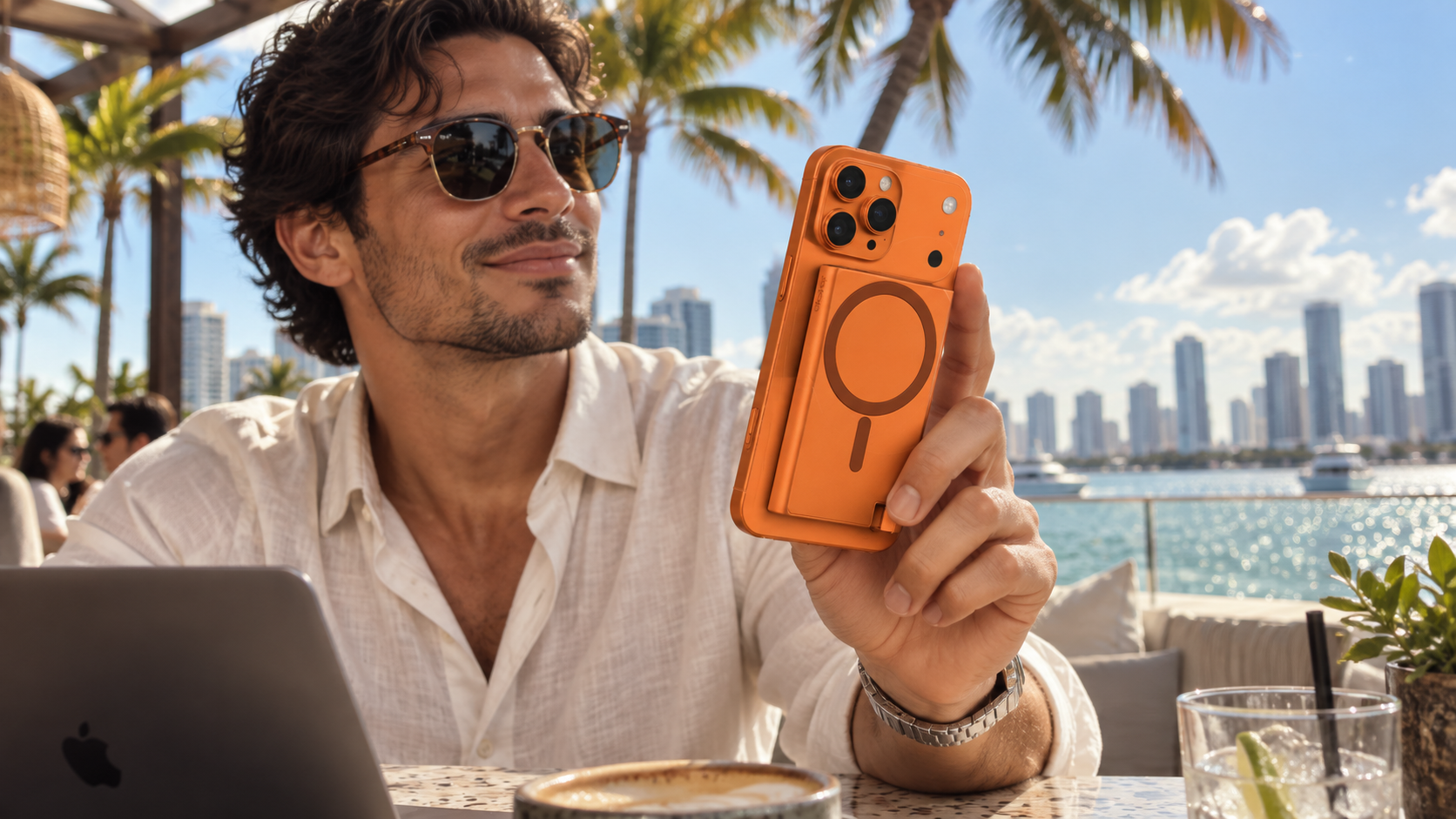
Olivier Momma Built Ekster in the Netherlands — But America Was in the DNA From Day One
Ekster started with two Dutch students questioning why the wallet had barely changed in a century. A decade later, the Amsterdam-born brand has reached more than two million customers, with the United States becoming a central part of its growth story.
For most European companies, America comes later. Build the company at home. Prove the product in Europe. Then figure out how to enter the United States.
Olivier Momma’s story with Ekster followed a very different route.
America was there from the beginning.
In 2015, Momma and fellow Dutch student Rick Scharnigg were living in the United States on a Fulbright scholarship when they started discussing something remarkably ordinary: their wallets.
The traditional leather bifold had hardly evolved even as the way people paid was changing rapidly. Cards were replacing cash, contactless payments were emerging and smartphones were becoming part of everyday commerce.
Yet people were still carrying essentially the same wallet.
“What would a wallet designed for the 21st century actually look like?”
From Hong Kong to America
The idea had been forming even before Ekster formally existed. Momma grew up internationally, spending parts of his life in places including Tokyo, Hong Kong and the Netherlands.
During time in Hong Kong, he noticed how quickly mobile payments were changing consumer behavior in Asia while Europe and the United States were still operating somewhere between cash, cards and digital payments.
If payments were changing, why wasn't the object carrying those payments changing with them?
Together with Scharnigg and co-founder Richard Canneman, Momma began developing a slimmer, technology-enabled alternative.
The early Ekster wallet combined a card-ejection mechanism, RFID protection and eventually tracking technology designed to solve another common problem: losing your wallet.
There was no established company behind it. The founders produced prototypes themselves, created their own campaign material and leaned heavily on crowdfunding rather than traditional venture capital.
Their first major test was Kickstarter.
It worked.
In its first year, the team raised roughly $1 million through crowdfunding, giving the founders something more valuable than capital alone: evidence that people actually wanted the product.
The original Parliament Wallet subsequently gained coverage from publications including CNN, Forbes, CNET and Mashable.
Building a Dutch company for American consumers
What happened next makes the Ekster story particularly relevant for Scaling in America.
The founders did not need to relocate the entire company to the United States to build a significant American business.
Ekster remained rooted in the Netherlands while operating as a digitally native international brand. And America became central to the economics.
By 2024, Ekster had grown to roughly €40 million in revenue, with the majority of sales coming from the United States, according to co-founder Richard Canneman.
The company built local partnerships and infrastructure that allowed its Dutch team to operate the American market without needing to constantly be physically present in the United States.
That is a different model of U.S. expansion from opening offices, hiring large local teams and building physical infrastructure.
Ekster essentially exported the brand while localizing the machinery around it.
Performance marketing, e-commerce infrastructure, fulfillment and partnerships allowed an Amsterdam company to behave increasingly like an American consumer brand.
The model eventually took Ekster beyond online sales. The company entered Nordstrom's New York City flagship, giving a brand born through crowdfunding and direct-to-consumer e-commerce a physical presence inside one of America's best-known department stores.
From a wallet company to a carry brand
Perhaps the bigger founder lesson is that Momma did not treat the original product as the company.
The wallet was the entry point.
Over the following decade, Ekster expanded into cardholders, trackers, bags, travel products and other everyday-carry accessories.
Today, the company says its ecosystem has been used by more than two million people, while its team has grown to around 45 people across 11 countries. Ekster is also a certified B Corporation.
The company has deliberately repositioned itself around a broader idea: helping people move through everyday life more efficiently.
That evolution matters. Consumer-product companies built around a single viral product often struggle once growth in the original category starts slowing. Ekster instead used the wallet to establish a customer base, brand and distribution system that could support adjacent products.
In 2026, Ekster is celebrating its 10th anniversary.
The founder behind the product
Momma's international background is particularly relevant to the company he ultimately created.
Growing up across different countries meant adapting repeatedly to new environments, cultures and consumer behaviors. He has spoken about Japan's influence on his appreciation for precision, craftsmanship and design.
That worldview is visible in Ekster.
It is a Dutch-founded business influenced by Asian payment behavior, conceived partly in America, built through global e-commerce and ultimately scaled heavily through U.S. consumers.
And that makes the company's story harder to categorize simply as a Dutch brand expanding abroad.
Ekster was international almost from day one.
Why this matters
Ekster offers an interesting counterpoint to the traditional European-to-American expansion playbook.
The company did not wait until it was large in Europe before attacking the United States.
The founders encountered the problem while living in America, validated the solution through a global crowdfunding platform and built the U.S. into the company's commercial engine early.
By 2024, America was already responsible for the majority of a roughly €40 million business.
For European consumer founders, that may be the more important lesson from Olivier Momma's story.
Entering America does not necessarily begin with an American headquarters.
Sometimes it begins much earlier — with designing the product, brand, distribution and marketing strategy for an American customer from the start.
Ekster did that with something as ordinary as a wallet. A decade later, it has become something considerably larger.