How Georgia courted Audi’s planned $4B first US factory
A two-year recruitment effort helped bring Audi’s planned first US factory to Middle Georgia, but board approval and tariff-relief terms remain unresolved.
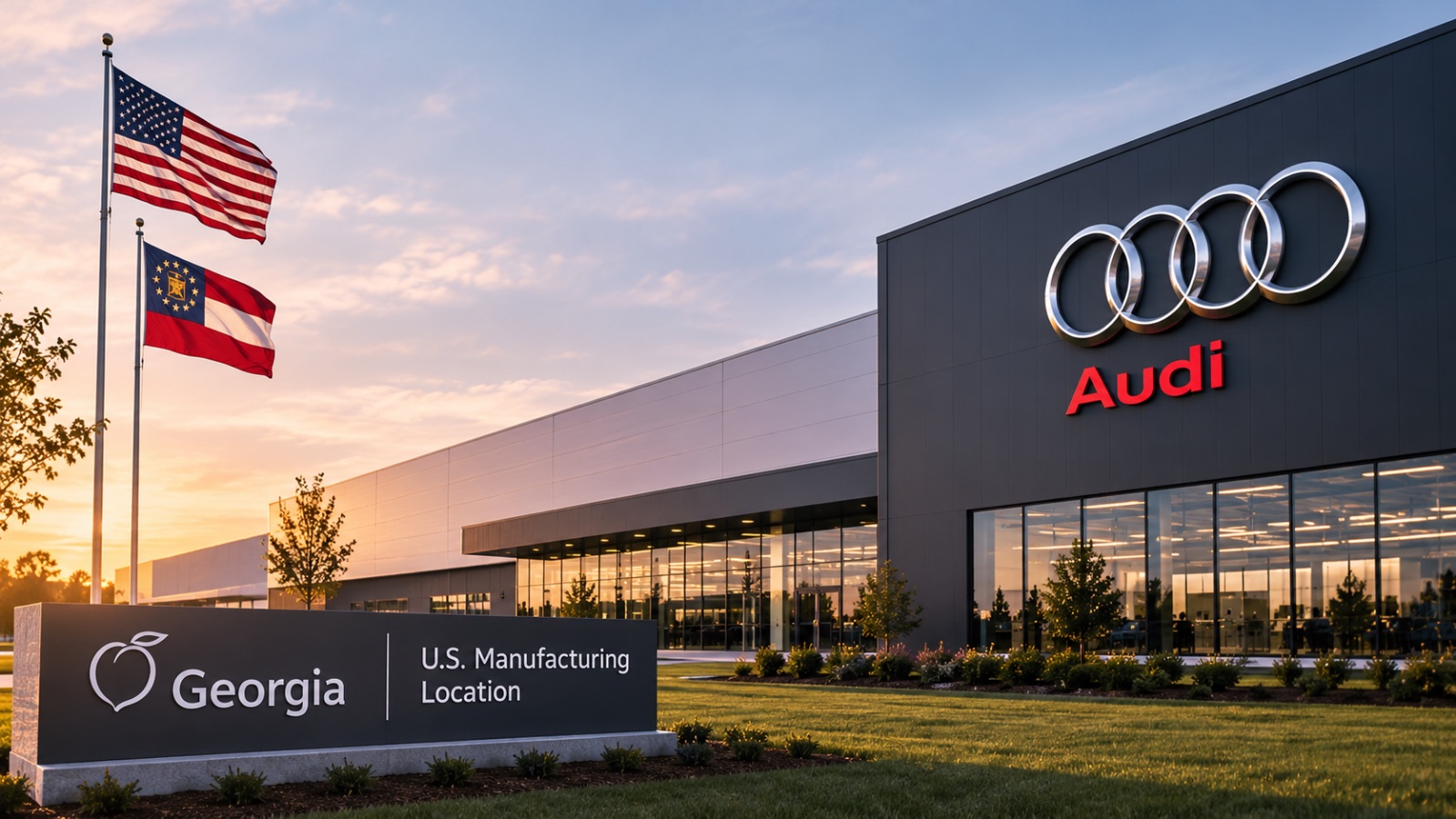
Audi’s plan to build its first US manufacturing facility in Middle Georgia follows a two-year recruitment campaign that began with Governor Brian Kemp spotting a report about the German carmaker’s American ambitions. The roughly $4 billion project promises about 4,500 jobs, but remains subject to approval by parent Volkswagen’s supervisory board.
The proposed factory in Peach County, near Fort Valley, would mark a significant change for Audi’s US business: moving from imported vehicles towards local production. For Georgia, it would add another major automotive investment to a manufacturing base that has already attracted Kia, Hyundai and Rivian.
President Donald Trump and Audi chief executive Gernot Döllner presented the plans at an October 24 rally in Georgia. Behind that public announcement lay quieter negotiations over the site, regional support and the economics of manufacturing in a market where tariffs have put Audi under pressure.
A quiet opening in Munich
According to The Atlanta Journal-Constitution, Kemp asked Georgia economic development commissioner Pat Wilson to arrange a meeting with Audi while the governor was in Germany for the Munich Security Conference in February 2025.
Kemp and Wilson met Döllner and his leadership team in a small hotel conference room on a Sunday. They brought a pitch book showcasing the Peach County industrial site, but knew little about Audi’s plans. Kemp recalled that the executives barely spoke.
The pursuit subsequently lost momentum before talks resumed, the AJC reported. Georgia continued marketing the site to other prospects, while relationships established in Munich helped keep the Audi discussions alive.
By September 2026, a delegation of Georgia officials, including Macon Mayor Lester Miller, travelled to Ingolstadt to meet Audi’s leadership. That visit brought regional officials into the recruitment effort shortly before the public announcement.
Selling more than land
Georgia’s pitch rested on preparation as well as access to executives. State and local leaders had begun acquiring land for the Middle Georgia MegaSite along Georgia Highway 96 in 2022, according to the AJC. Officials held out for a major employer rather than dividing the property among smaller projects.
Kemp described site readiness, workforce development and logistical advantages as important to attracting large manufacturers. The broader strategy was to prepare industrial locations before companies came looking, reducing the work needed to turn a site selection into an operating factory.
An established automotive supply base also strengthens the proposition. The AJC reported that suppliers serving Georgia’s existing assembly plants, together with those supporting Volkswagen and BMW in neighbouring states, could help support Audi. The company would be entering a regional manufacturing network rather than building one entirely from scratch.
Tariffs reshape the investment case
Road & Track reported that the planned plant would produce 200,000 vehicles annually by the early 2030s. Audi currently imports its US models from Europe or Mexico, making domestic production a significant strategic departure rather than simply an expansion of existing American assembly capacity.
The immediate commercial backdrop is difficult. Bloomberg reporting published by The Straits Times said Döllner acknowledged on October 25 that Audi was losing money in the US. Volkswagen is simultaneously cutting costs and reshaping its European operations amid weak demand, Chinese competition and the expense of shifting towards electric and software-defined vehicles.
Tariff relief could influence the economics before the Georgia plant opens. Citing The Wall Street Journal, Road & Track reported that Audi executives had received assurances about a prospective US programme offering relief to automakers investing in domestic production. Its terms had not been announced, leaving the potential benefit uncertain.
Approval remains a hurdle
The announcement also created friction in Germany. The Straits Times reported that union leaders criticised Döllner’s appearance at Trump’s campaign rally. Worker representatives hold half the seats on Volkswagen’s supervisory board, which must approve the factory.
For Georgia, the recruitment campaign has secured a major proposed investment, not yet an operating plant. For Audi, the next steps require aligning US production ambitions and prospective tariff benefits with corporate approval and workforce negotiations at home.