
Riverlane Picks Maryland for U.S. Quantum Headquarters
The Cambridge quantum company is opening its U.S. headquarters in College Park, placing research, talent and commercial growth inside Maryland’s quantum ecosystem.
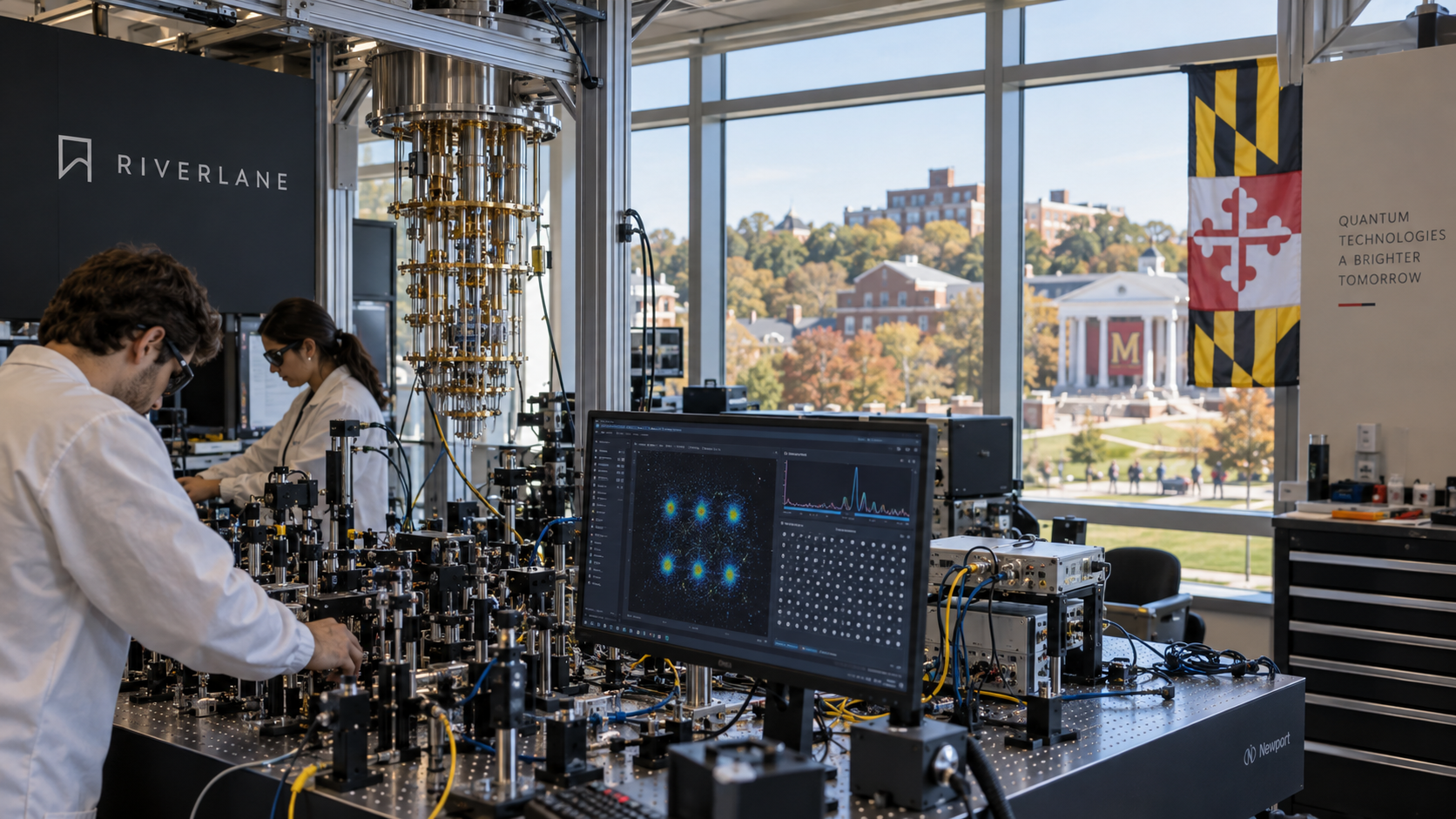
British quantum computing company Riverlane is establishing its U.S. headquarters in College Park, Maryland, deepening its American presence as the race to build commercially useful quantum computers accelerates.
The Cambridge-based company plans to open the headquarters in Discovery District Maryland, steps from the University of Maryland campus. The site will combine office and laboratory space and support research collaboration, customer engagement and business development.
Riverlane already has a U.S. office in Boston, but the Maryland expansion gives the company a larger base inside one of America's emerging quantum technology clusters.
Why Riverlane chose Maryland
For Riverlane, the location decision appears to be as important as the headquarters itself.
Maryland has built a concentrated quantum ecosystem around the University of Maryland, federal research institutions and private technology companies. The region includes the Joint Center for Quantum Information and Computer Science, the National Institute of Standards and Technology, the U.S. Army Research Laboratory and Johns Hopkins University Applied Physics Laboratory.
Technology companies including Microsoft, IonQ and IQM also operate in the region, creating a combination of research, talent, government links and commercial activity that is particularly valuable for a specialist deep-tech company.
“Establishing our U.S. headquarters in Maryland puts us at the heart of an exceptional ecosystem of researchers, industry leaders and government partners working to advance quantum.”
Riverlane says the Maryland base will also help it expand existing partnerships and build new relationships across academia, industry and government.
A university partnership built into the expansion
The company is pairing the new headquarters with a strategic collaboration with the University of Maryland focused on quantum error correction research and talent development.
The collaboration is expected to create student fellowships, teaching and mentorship opportunities while supporting joint research and workforce development.
That relationship gives Riverlane access to more than laboratory space. It creates a potential pipeline of researchers and engineers in a field where specialized technical talent remains scarce.
For Maryland, the deal also supports its broader Capital of Quantum initiative, which is designed to bring together research institutions, federal agencies, investors and companies. The initiative is targeting $1 billion in quantum-related investment by 2030.
Riverlane is solving the error problem
Riverlane operates in one of the most technically important layers of quantum computing: quantum error correction.
Quantum computers are extremely sensitive to errors, making it difficult to run long and reliable calculations. Riverlane's Deltaflow system is designed to detect and correct those errors in real time so quantum hardware can eventually operate at much larger scale.
The company says it works with more than 60% of the world's quantum computer companies and with leading high-performance computing centers.
Riverlane was founded in 2016 and remains headquartered in Cambridge, with additional operations in Boston and Delft. It says it has raised more than $120 million in private funding.
Building a larger American team
The College Park headquarters is also expected to support further hiring in the United States.
Riverlane says it is recruiting across research, engineering, commercial and operational roles as it expands its American business.
That makes this more than a symbolic headquarters announcement. The company is putting research capability, customer activity and local hiring into the same U.S. location.
What this means for European companies
Riverlane's move shows why the best U.S. location for a European company is not always New York, San Francisco or another obvious corporate hub.
For specialized industries, the surrounding ecosystem can matter more than the size or profile of the city itself. Access to universities, government laboratories, customers, talent and industry partners can turn a smaller market into a strategically stronger location.
That is especially true in deep tech, where expansion often depends on scientific talent and institutional relationships rather than simply sales coverage.
Riverlane already had an American foothold in Boston. Its decision to place its U.S. headquarters in College Park suggests the next stage is about embedding itself more deeply inside the country's quantum ecosystem.
For European founders considering America, the broader lesson is straightforward: choose the ecosystem that helps the company scale, not simply the city with the strongest brand.