Hydro breaks ground on $53.5m Pennsylvania extrusion press
The Norwegian aluminium group is upgrading its Cressona plant to expand indirect extrusion capacity while warning that US equipment tariffs complicate domestic investment.
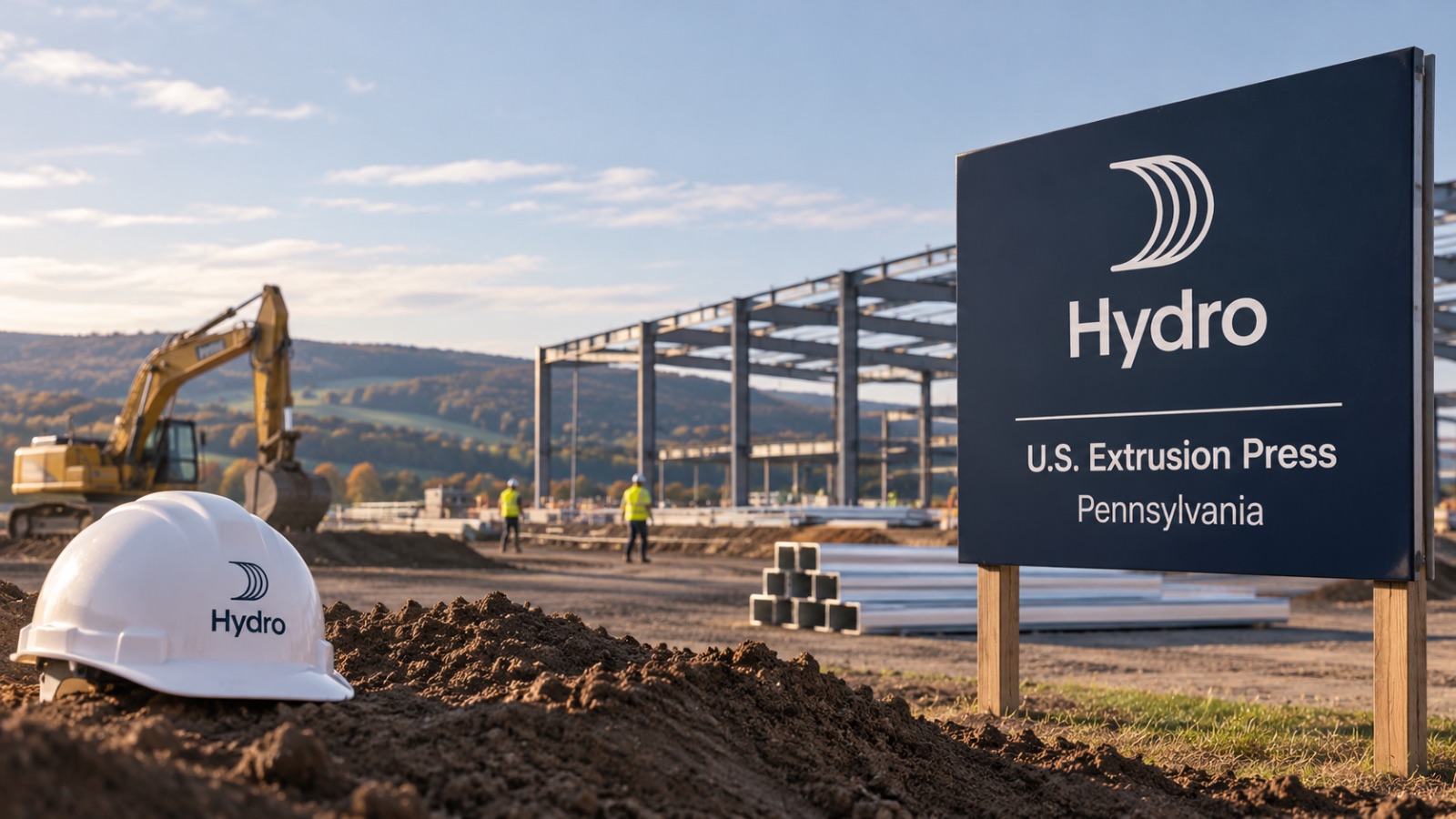
Norway’s Hydro has broken ground on a $53.5 million indirect extrusion press line at its Cressona, Pennsylvania, facility, adding capacity and modernising an established manufacturing base rather than entering a new US market. The groundbreaking took place on October 27, 2026, with operations expected to begin in the first quarter of 2028.
The 5,900-tonne press line will replace equipment dating from the 1950s. Hydro says the investment will introduce Industry 4.0 technology and advanced automation, improve energy efficiency and safety performance, and strengthen its North American manufacturing footprint.
The project also highlights a tension in the company’s US expansion strategy: Hydro is committing capital to domestic production while warning that tariffs on specialised machinery imported from Europe can make those investments more expensive and less predictable.
More capacity for transport and electrical customers
Hydro links the expansion to growing demand for indirect extrusions in commercial transportation, automotive and electrical markets. Customers in those sectors increasingly require high-performance aluminium profiles with consistent dimensions, superior grain structure and consistent mechanical properties, according to the company.
The commercial rationale is therefore about both capacity and product quality. Hydro expects the new line to increase the volume of indirect extrusions it can supply while upgrading the production capabilities used to meet customers’ technical requirements.
“This project will improve efficiency, enhance product quality, and expand our indirect extrusion capacity to serve the growing needs of our key customers,” said Mike Hammer, vice president and general manager of Hydro Extrusion North America’s Industrial and Distribution Region.
For the Norwegian group, the move is a further investment in serving North American customers through an existing local production network. The announced timetable puts the operational benefits in early 2028, rather than providing an immediate increase in available capacity.
Building on an established US footprint
Cressona is one of the world’s largest aluminium extrusion facilities, according to the report in Aluminium International Today. It sits within a substantial Hydro presence in the United States: nearly 6,000 employees and 19 production sites across 14 states.
Jeff Lehman, business unit president at Hydro Extrusion North America, described Cressona as the “keystone” of the company’s North American operations and said Hydro had invested more than $150 million in the site over the preceding three years.
That spending makes the new press part of a sustained programme at an existing industrial location, not a standalone commitment. The announcement does not specify additional jobs or quantify the increase in annual production capacity, so its employment and output effects remain undefined.
Equipment tariffs complicate investment
Alongside the project, Hydro outlined plans to invest more than $800 million over the next five years. But the company also raised concerns about US tariff policy and its effect on the competitiveness of domestic manufacturing.
The issue is access to capital equipment: extrusion presses and other specialised machinery produced only in Europe face elevated and frequently changing US tariffs, according to the report. Hydro argues that these duties increase costs and create uncertainty for manufacturers investing in US operations.
“We remain fiercely committed to investing in our US operations, but the aluminium industry needs more nuanced trade policies that do not increase the cost of capital equipment and hinder industrial growth,” Lehman said.
Cressona illustrates the distinction between manufacturing locally and sourcing every part of a factory locally. Hydro is expanding its US production capabilities, but its warning underscores how dependence on European equipment can expose domestic investment programmes to trade-policy costs.