Genesis AI raises $500m to prepare US robot production in 2027
The French robotics startup, valued at $3.5 billion with Nvidia among its investors, plans to build an American supply chain and scale industrial deployments.
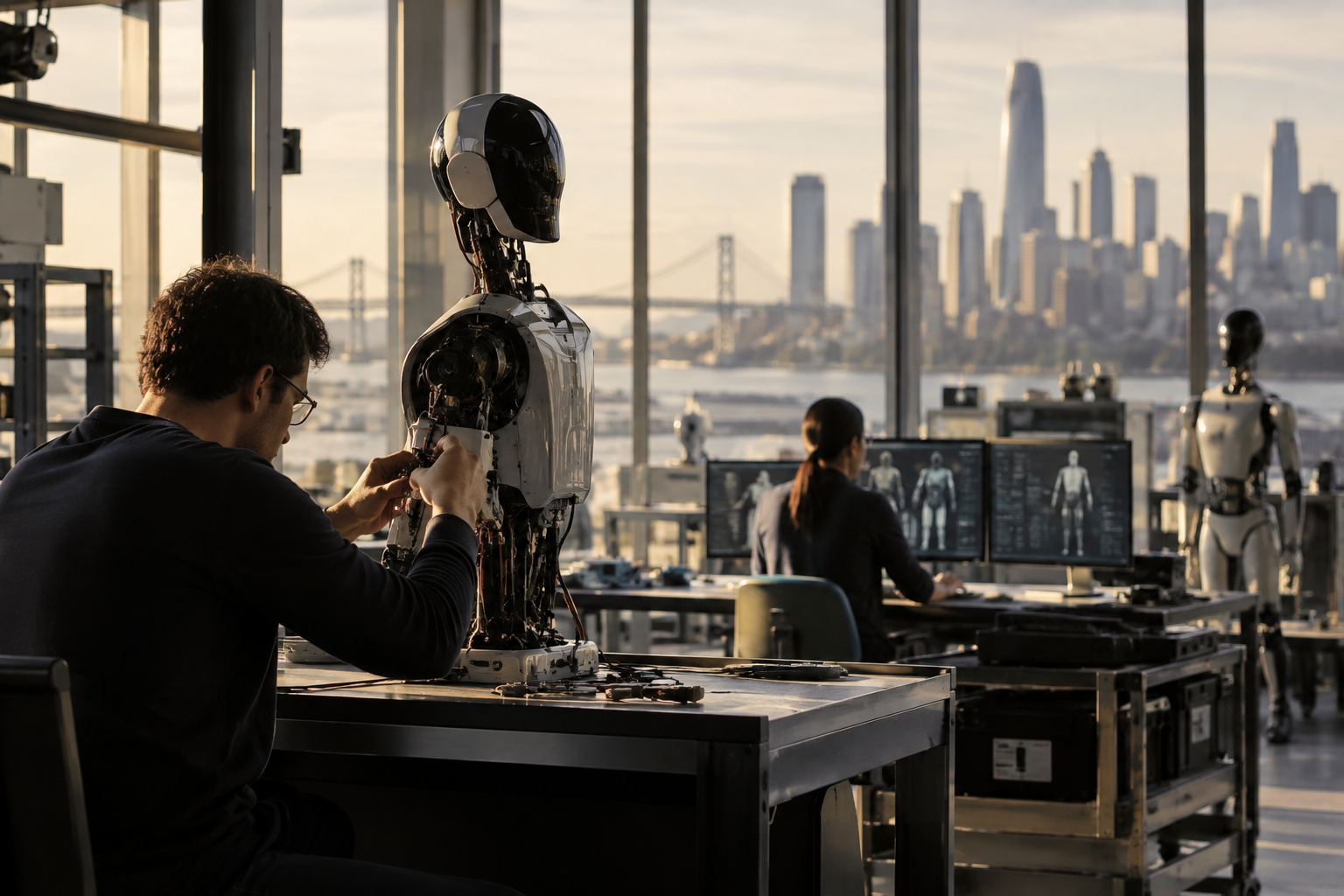
French robotics startup Genesis AI has raised $500 million in Series A funding at a $3.5 billion post-money valuation as it prepares to start large-scale robot production in the United States in 2027. The financing backs an explicitly US-first strategy: establish a domestic supply chain, work with contract manufacturers and secure American customers before expanding into other European markets.
The round, announced on November 17, was co-led by Khosla Ventures, Premji Invest and Eclipse, with participation from Nvidia, Bpifrance, Eric Schmidt and Xavier Niel, according to BigGo Finance. It follows a $105 million seed round in July 2025, bringing the company’s disclosed funding to $605 million.
Genesis, which is headquartered in France and has an office in San Carlos, California, plans to direct the new capital towards production of its flagship Eno robot, data collection, AI training and improved hand manipulation. Hiring and computing infrastructure are also priorities. The production location within the US and planned manufacturing volumes have not been disclosed in the supplied reporting.
An American industrial starting point
The US move goes beyond adding a sales presence. Genesis intends to make America both a production base and an initial customer market, tying its manufacturing plans to deployments in factories and warehouses. That makes the next phase a test of whether it can turn a small robot fleet into a repeatable industrial offering.
A partnership with South Korea’s LG CNS provides one route into those customers. Announced in June 2026, the collaboration covers evaluation and deployment in manufacturing and logistics, starting with LG facilities and industrial customers in the United States, according to The AI Insider. BigGo reports that testing remains small-scale, with broader customer deployments planned for 2027.
Genesis has also been building its commercial leadership. In March, it appointed Vivian Sun as vice president of commercial and strategy to lead commercialization, partnerships and market expansion. Sun previously held leadership roles at Amazon, Waabi and TuSimple.
Building the robot and its learning system together
Eno is a two-armed mobile robot with a wheeled base and a three-segment folding body, rather than a fully humanoid machine. Its structure allows it to fold into a compact space and extend to near-human height. Manufacturing, logistics and laboratories are the initial target environments; services and home applications sit further along the company’s roadmap.
Co-founded by former Mistral AI researcher Théophile Gervet, Genesis develops its AI, hardware and training systems together. It designs components including actuators, motors, reducers and dexterous hands in-house, while using Nvidia chips for computing. Nvidia’s participation therefore adds an equity relationship alongside an existing technology connection.
Its training approach starts with people doing ordinary work. More than 100 workers worldwide use sensor-equipped gloves and cameras to capture finger movements, contact forces and first-person views. The robot’s human-proportioned hands are designed to learn from that information through Genesis’s GENE model, while the Genesis World simulation platform provides virtual testing.
The strategic bet is that controlling those elements together will shorten the loop between a failure on a customer site and improvements to software or hardware. It also gives Genesis responsibility for several difficult tasks at once: model performance, mechanical reliability, manufacturing and deployment.
Durability remains the commercial hurdle
The funding is substantial, but the installed base remains limited. Genesis has produced only 30 to 40 Eno units for trials with a small number of customers. XenoSpectrum reports that the company has not disclosed revenue or the number of paying customers.
The most immediate constraint is hardware durability: current dexterous hands need replacement after several weeks of daily use, according to BigGo. Frequent replacement would add parts, maintenance and downtime costs as deployments grow. The reported demonstration also used robotic arms rather than a publicly operating Eno, underscoring the distinction between individual task demonstrations and a proven production system.
For Genesis, the decisive US milestone is therefore not simply starting production in 2027. It is demonstrating that robots manufactured at scale can complete customer workflows reliably enough to justify their operating costs.