France’s Gama raises €15m with US backing to scale satellite solar arrays
Draper Associates joins the French company’s seed round as Gama prepares a production line near Paris and a first demonstration delivery in summer 2027.
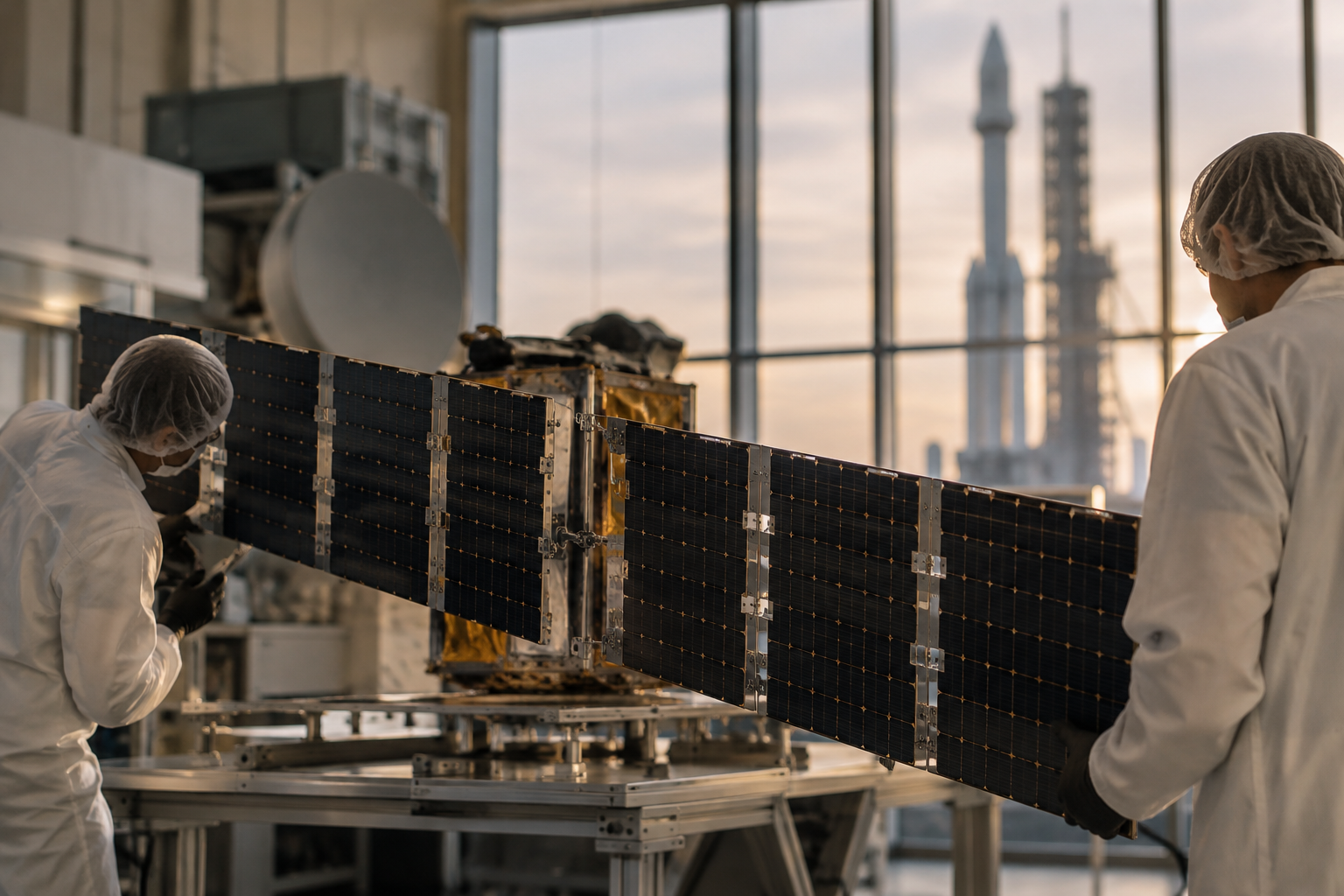
French satellite technology company Gama has raised €15 million in seed funding from Transition, Planet A, US-based Draper Associates and Manta Ray to industrialise its ultra-light deployable solar arrays. Announced on November 12, 2026, the round will finance its first Wing production line in Ivry-sur-Seine, near Paris, expanded testing capabilities and around 60 engineering hires.
The financing strengthens Gama’s transatlantic connections, but it is not an announcement of a US operating expansion. Its disclosed manufacturing investment remains in France. The American links are through capital, senior engineers with SpaceX experience and a supply partnership with a constellation provider founded by former Starlink engineers.
Turning power demand into a manufacturing opportunity
Gama is targeting a constraint facing increasingly power-hungry satellites: larger solar arrays must still fit inside a rocket fairing for launch. Direct-to-device networks, broadband constellations and orbital data centres are raising electrical requirements, creating demand for power systems that can deploy large surfaces from a compact package.
Wing combines solar generation, sun-tracking array rotation, power management and optional energy storage in an integrated unit. Gama also supplies control algorithms, designed to run on customers’ flight computers, to keep satellites stable with large arrays attached. The company says this combination of hardware and software is designed to accommodate higher power requirements as satellites grow.
Its competitive proposition centres on cost and production speed. According to Tech.eu, satellite manufacturers typically rely on specialised III-V solar cells supplied in small volumes by a limited number of producers, with lead times of a year or more. Gama instead adapts high-volume terrestrial silicon cells for use in space, seeking to reduce dependence on that specialised supply chain.
Gama targets six-month lead times for Wing once its production line is operating, with further reductions as volumes increase. That remains a target rather than an established delivery record; its ambition to achieve an industry-leading cost per watt is likewise a product goal.
US connections, French production
In September 2026, Gama announced a partnership to supply deployable solar arrays for Eclipse Space’s satellite platforms. Eclipse, which provides customer-owned satellite constellations, was founded by former SpaceX Starlink engineers. Gama is scheduled to deliver its first demonstration unit in summer 2027, providing a concrete milestone for the new production effort.
Gama’s own engineering leadership also draws on the American satellite industry. Chief technology officer Daniel Chapman and vice-president of engineering Duncan Adams both worked on Starlink hardware and production lines at SpaceX. Their experience is relevant to the central challenge Gama now faces: moving from product development to repeatable manufacturing.
“At SpaceX we learned that building one great piece of hardware is not the hard part. Building thousands is,” Chapman said in the funding announcement.
For Gama, these connections link a French manufacturing base to expertise and commercial relationships developed around the US constellation industry. The announcement does not disclose a US office, factory or hiring programme, nor does it identify how much of future demand will come from American customers.
From solar sails to a commercial power product
Founded in 2022, Gama initially pursued solar sails and launched its Gama Alpha mission in 2023. Tech Funding News reports that the company previously raised €2 million and shifted towards satellite solar arrays after encountering difficulty financing its solar-sail business. Chief executive and co-founder Andrew Nutter said the experience developing large deployable structures was transferable to the new product.
The company currently has 30 people, according to Tech Funding News. Its planned recruitment spans mechanical engineering, power electronics, software, production and testing. With US investment supporting production in France, the immediate test is industrial execution: commissioning the line, building the team and delivering the demonstration hardware on schedule.