Singulus lands SpaceX solar equipment deal as Musk touts 100 GW ambition
The German machinery maker has signed a first production-line contract worth more than €60 million for SpaceX’s Texas satellite operation, while the wider rollout remains undefined.
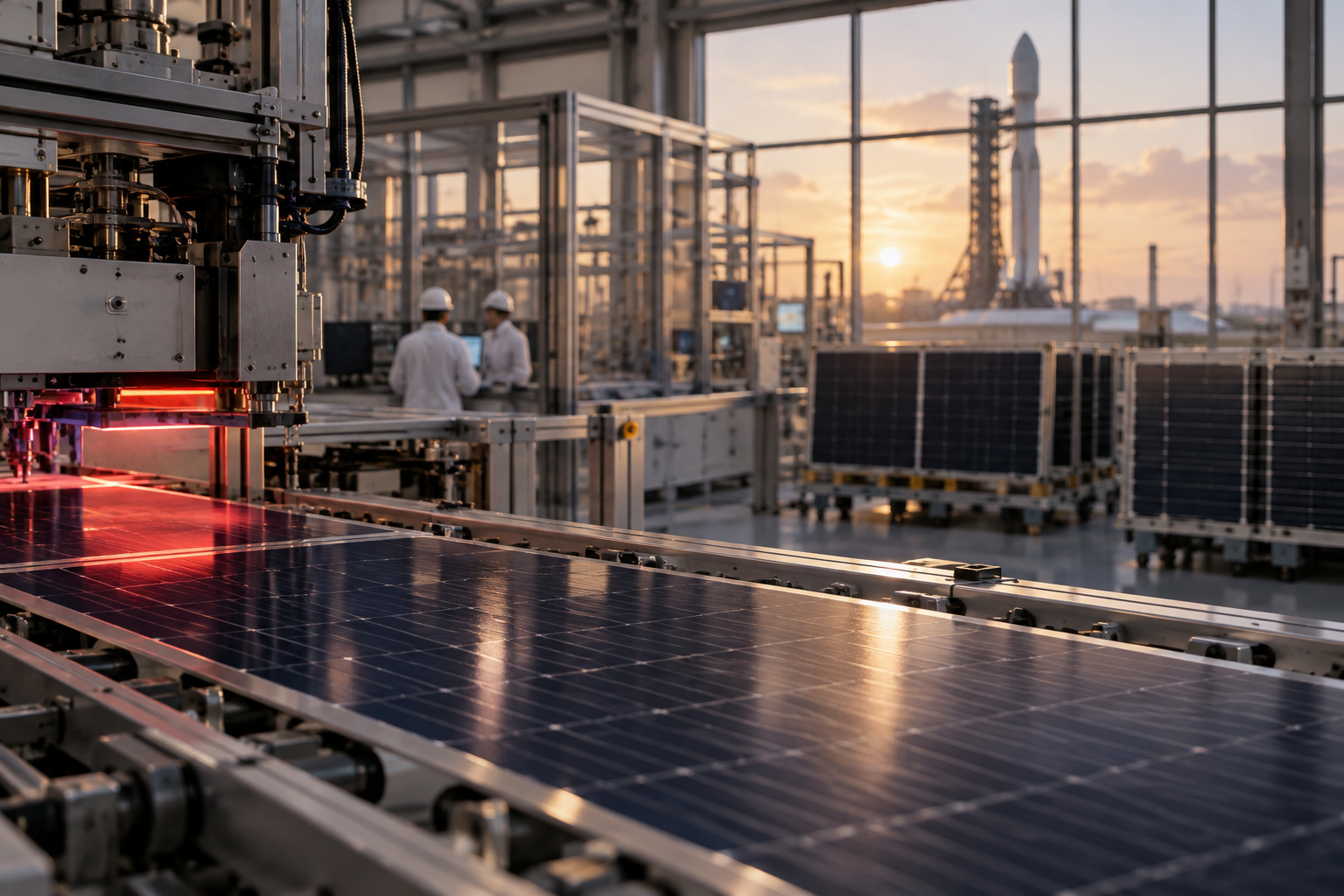
Germany’s Singulus Technologies has signed a contract to supply SpaceX with a turnkey solar-cell production line supporting satellite manufacturing in Bastrop, Texas. The first line is worth more than €60 million and is scheduled for delivery in the first half of 2027, according to reporting published by Yahoo Finance.
The agreement gives the Kahl am Main machinery maker a substantial American customer and a route into the supply chain for Starmind, SpaceX’s planned fleet of solar-powered AI computing satellites. It also represents an unusually large commitment relative to Singulus’s existing business: the initial contract exceeds its entire 2025 revenue.
The headline scale, however, needs qualification. Elon Musk said on November 10 that SpaceX had ordered “100 GW/year of HJT solar manufacturing equipment from Singulus in Germany.” Singulus’s announcement, as reported by Yahoo Finance and pv magazine USA, describes one contracted line and a partnership intended to support more than 100 GW of production equipment, without specifying an annual timeframe.
A signed line, a much larger ambition
The equipment will manufacture heterojunction, or HJT, solar cells. Additional production lines are planned under the strategic partnership, but the disclosed agreement does not establish a delivery schedule or total contract value for the wider rollout.
Neither company has disclosed the first line’s output or the efficiency of the cells, according to the Yahoo Finance report. The 100 GW figure therefore should not be read as the capacity of the initial line, electricity already being generated, or computing capacity operating in orbit.
The distinction matters for assessing Singulus’s US opportunity. A first contract worth more than €60 million is a concrete manufacturing commitment. Delivering equipment at the scale Musk describes would require a much broader expansion whose timing and commercial terms have not been disclosed.
A transformative customer for a small German supplier
Singulus was founded in 1995 through a management buyout from Leybold and built its reputation supplying machinery for CDs and DVDs. Its product range now includes coating equipment for solar cells, semiconductors and medical packaging, alongside optical-disc production lines.
The company had 325 employees at the end of September. It reported €48.3 million in revenue and a €14.2 million net loss for 2025, with €6.2 million in year-end cash, according to Yahoo Finance’s account. Those figures underline both the importance of the SpaceX order and the operational challenge of delivering a contract larger than its previous annual sales.
SpaceX is also a source of financing. The partnership began in March 2026, and Singulus said its customer provided significant funding that month and again in October through a subordinated secured loan. The relationship thus extends beyond equipment procurement into financial support for the supplier.
Texas links solar manufacturing to orbital AI
Under the partnership, Singulus will develop both high-performance solar cells and the equipment to produce them, using technologies already deployed at scale, pv magazine USA reported. Its platform combines wet chemistry, vacuum coating and thermal processing. The strategic opportunity is to industrialize those capabilities for SpaceX’s satellite programme, rather than simply sell a standalone machine.
Texas is also attracting other HJT manufacturing projects. Pv magazine USA identifies Toyo’s planned 1.5 GW factory and SEG Solar’s planned 4 GW plant near Houston. These projects provide context for the state’s growing solar manufacturing activity, though they are not evidence of direct competition for SpaceX’s satellite order.
For Singulus, the disclosed US move is an equipment-supply expansion tied to an American customer’s factory, not an announced factory of its own. The next concrete milestone is delivery of the first line in early 2027; subsequent orders and capacity disclosures will determine how far the partnership moves toward its much larger stated ambition.