Munich’s SE3 raises $30m led by Accel for autonomous defence software
US venture firm Accel is backing the Munich startup’s European expansion as SE3 develops spatial intelligence software for drones and ground vehicles.
Munich-based SE3 has raised $30 million (€27.04 million) in Series A funding led by US venture firm Accel to scale spatial intelligence software for autonomous systems. Keen Venture Partners, Lakestar and Seedcamp also participated in the round, announced on November 12, 2026.
The company will use the money to expand its engineering, commercial and operations teams and prepare to fulfil additional contracts. It plans to strengthen its presence in Germany and Ukraine, open a UK office and expand further across Europe.
The transatlantic connection is capital, rather than a confirmed US market entry. The announcement outlines no American office or US expansion plan. Accel is backing a business whose immediate priority remains European defence, but whose software approach puts it in a field that includes established US autonomy developers.
Software for mixed fleets
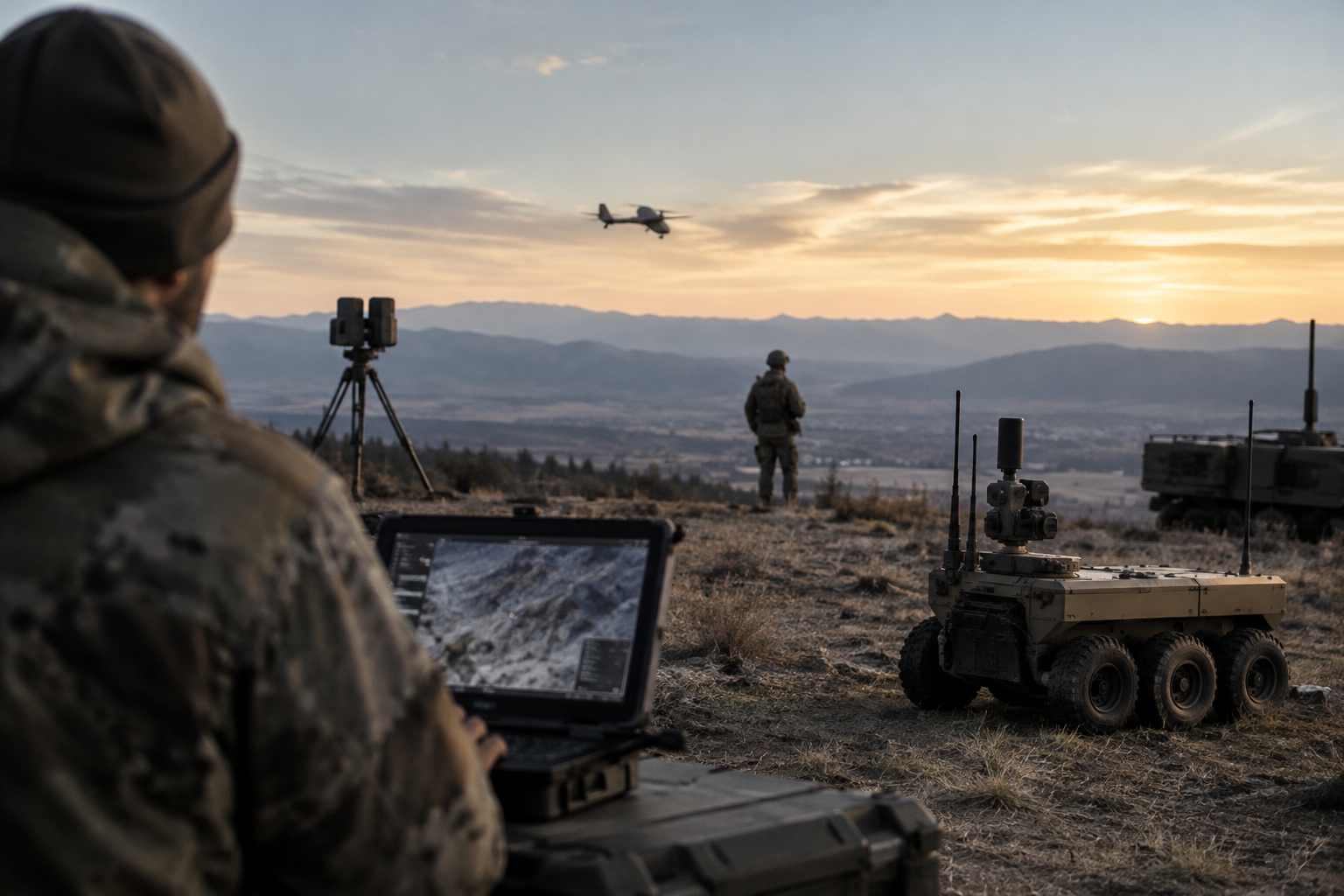
SE3 combines computer vision and AI to help machines interpret their surroundings and operate autonomously, including when satellite navigation is disrupted. Rather than build its own vehicles, it supplies a software layer designed to work across drones and ground vehicles from different manufacturers.
According to the company, its technology combines sensor data into a shared three-dimensional picture of the environment. The software uses that understanding to coordinate a swarm, adjusting individual systems’ routes, positions and behaviour to the terrain. Operators can issue voice commands, and processing runs on the devices themselves.
The intended benefit is particularly relevant in Ukraine, where SE3 says its technology is already deployed. Electronic warfare disrupts satellite navigation, while supervising large numbers of drones places growing demands on human operators. SE3’s proposition is to make those systems more autonomous without requiring customers to standardise on one vehicle manufacturer.
“Working in defence means our technology has to deliver under pressure in the field,” Lukas Köstler, SE3’s chief executive and co-founder, said in the funding announcement.
Research origins, early deployments
Founded in 2023, SE3 spun out of Professor Daniel Cremers’ computer vision laboratory at the Technical University of Munich. Köstler and co-founder Simon Klenk, now chief technology officer, were working on doctorates in computer vision and robotics there. Cremers is the company’s chief science officer.
Trending Topics reported that SE3 emerged from stealth in June 2026 with €5.5 million in seed funding led by Lakestar. The Series A follows that earlier financing within the same year; its valuation was not disclosed.
SE3 reports shipping thousands of systems over the past two years and working on multiple contracts with Ukraine and Germany’s armed forces, the Bundeswehr. It names HENSOLDT, Auterion and ERC System among its partners. Trending Topics reports that its software runs on Auterion’s Skynode onboard computer.
Those deployment figures are company-reported. Revenue and order values have not been disclosed, leaving the commercial scale behind the shipment count unclear.
US competition, European priorities
SE3’s manufacturer-neutral model aligns with procurement approaches intended to make equipment from different suppliers work together. These include the US Modular Open Systems Approach, or MOSA, and Germany’s MOSABw programme. That alignment helps explain the relevance of its architecture beyond Europe, but does not establish US customer traction.
The competitive field is already crowded. Trending Topics identifies Anduril’s Lattice and Shield AI’s Hivemind as US offerings in autonomous-systems software, alongside European developer Helsing. Partners such as Auterion are also developing autonomy capabilities, making clear differentiation important even within SE3’s existing ecosystem.
For now, the funding is directed towards delivering more European contracts and widening SE3’s regional footprint. Civilian applications, including robotics and emergency response, are planned for exploration from 2027. Its next commercial test is whether a shared software layer can translate existing deployments and partnerships into broader adoption across manufacturers.